
Sound Masking: Is it the right solution?
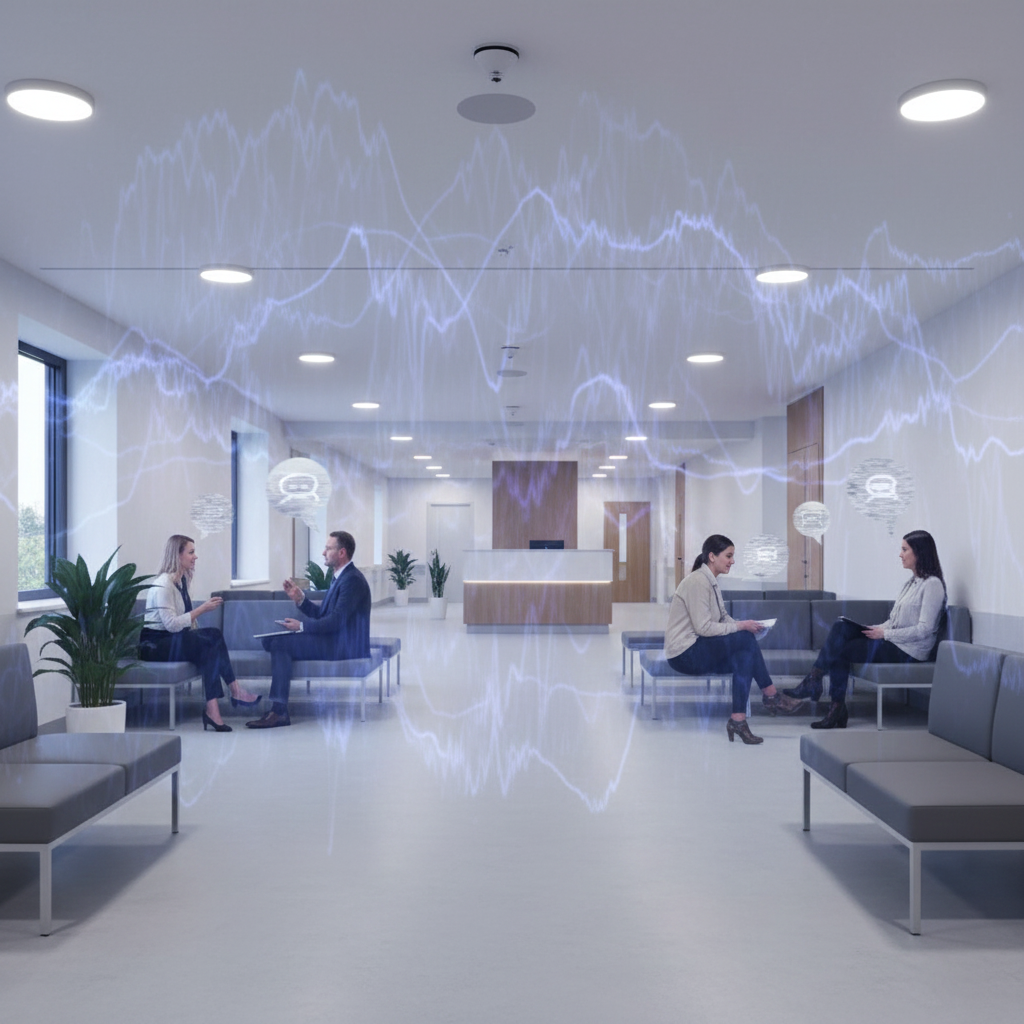
Sound masking is a powerful design tool that subtly improves privacy, reduces distractions, and enhances focus by adding a controlled background layer of sound. When applied thoughtfully—matching spectrum, level, and timing to the space and its users—it increases speech privacy without raising perceived noise, supports concentration in open-plan offices, and smooths acoustic transitions in public areas. But misuse or one-size-fits-all solutions can backfire: incorrect levels, inappropriate tones, or installation in spaces that need quiet can amplify irritation and reduce comfort. Effective sound masking requires measurement, customization, and ongoing tuning to the room’s function and occupancy. Used in the right application, it becomes an invisible ally for wellbeing and productivity; used poorly, it becomes just another distraction.
In today's open-plan offices, bustling healthcare facilities, and vibrant educational spaces, noise is a constant companion. While some ambient noise is unavoidable, too much can lead to distractions, reduced productivity, and — critically in healthcare — a significant breach of privacy. This is where sound masking steps in as an ingenious solution, creating an invisible shield that transforms noisy environments into productive and confidential spaces.
SOUND MASKING DOES NOT STOP SOUND!
What Exactly is Sound Masking, and How Does it Work?
Imagine trying to eavesdrop on a conversation in a quiet room versus a room with a gentle air conditioning hum. In the latter, the conversation becomes less distinct, not because the sound is louder, but because it blends into the background noise. This is the fundamental principle behind sound masking.
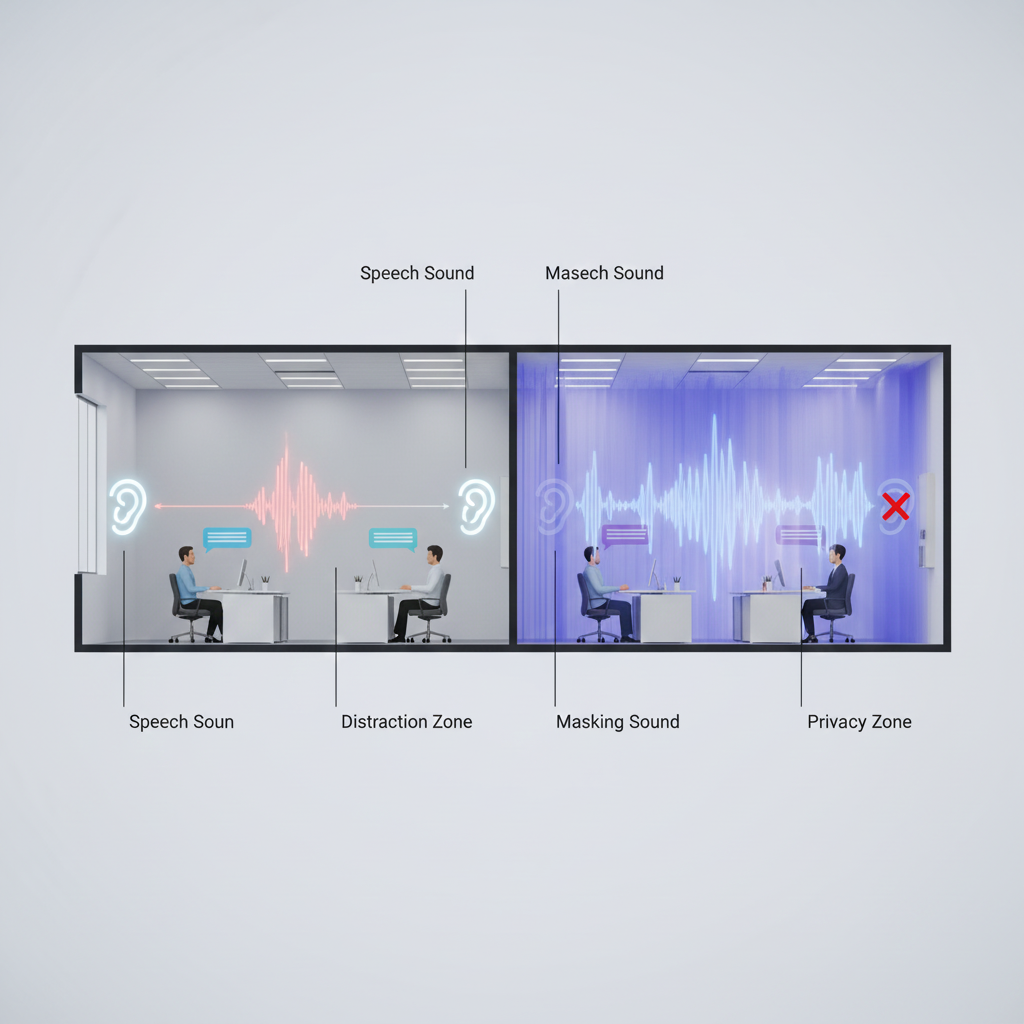
Sound masking systems introduce a low-level, unobtrusive ambient sound into a space. This sound is specifically engineered to be similar to the human voice frequency range, but without carrying any information or meaning. It's often described as a soft, whooshing, or airflow-like sound.
The magic happens when this engineered sound elevates the ambient noise floor of the environment just enough to make human speech less intelligible at a distance. It doesn't cancel noise; it makes distractions, especially conversations, fade into the background, improving overall comfort and speech privacy.
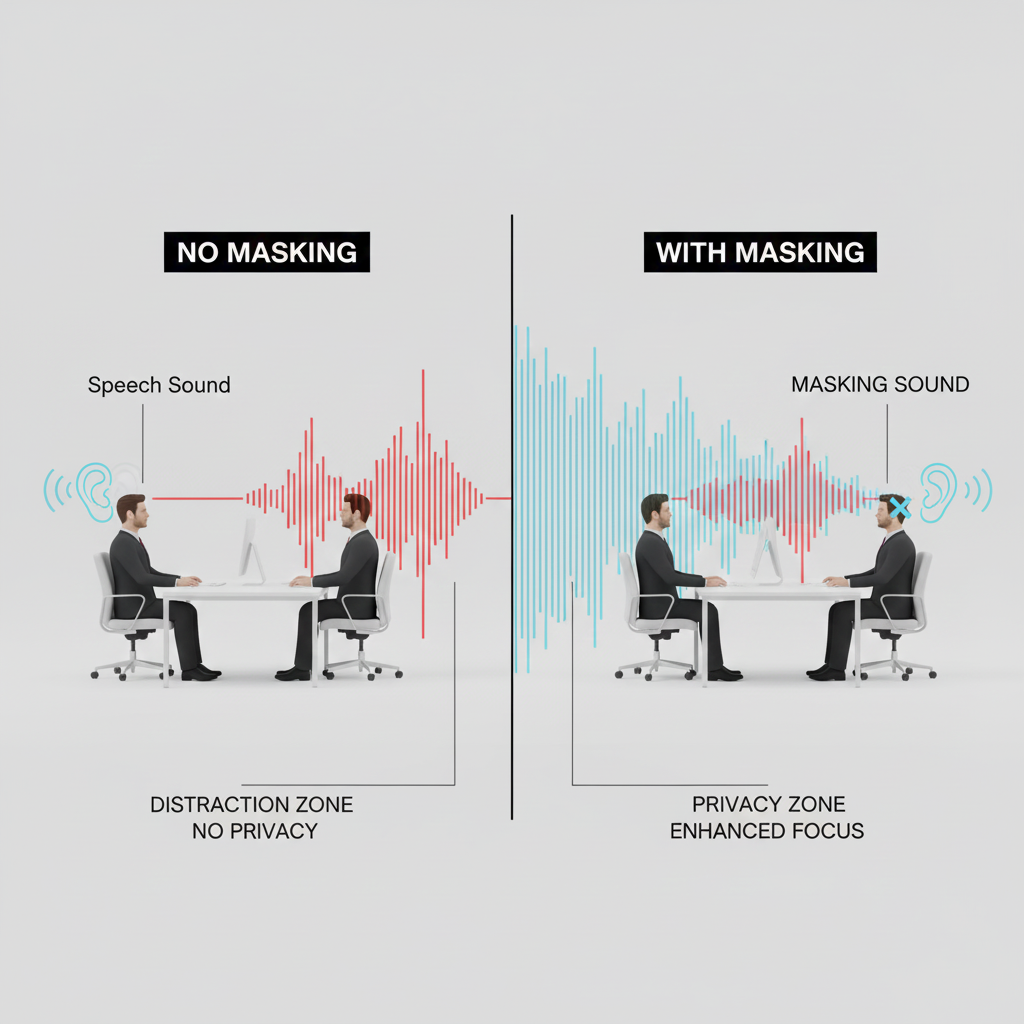
The magic happens when this engineered sound elevates the ambient noise floor of the environment just enough to make human speech less intelligible at a distance. It doesn't cancel noise; it makes distractions, especially conversations, fade into the background, improving overall comfort and speech privacy.
Key Benefits of Sound Masking:
Enhanced Speech Privacy: Crucial for confidential conversations in healthcare, legal, and corporate settings.
Reduced Distractions: Improves focus and productivity by minimizing disruptive sounds.
Improved Acoustic Comfort: Creates a more pleasant and less stressful environment.
Cost-Effective: Often a more economical solution than extensive architectural modifications for acoustic improvement.
Pros of Sound Masking (Active Solution)
High Speech Privacy: Most effective way to reduce speech intelligibility (the ability to understand conversations) in open areas.
Increases Focus/Productivity: Masks distracting conversations and sudden noises, reducing cognitive load on workers/staff.
Acoustic Comfort: Creates a consistent, low-level background sound that makes the overall environment feel calmer and less chaotic.
Discreet and Aesthetic: Speakers are installed in the plenum (above the ceiling grid) or under desks, making the system virtually invisible.
Scalable and Flexible: Easy to expand to new areas or adjust sound levels/zones via software when office layouts change.
Cost-Effective Alternative: Often much less expensive than extensive architectural modifications (e.g., building floor-to-ceiling walls) to achieve the same privacy level.
Cons of Sound Masking (Active Solution)
Higher Upfront Cost: Requires purchasing, installing, and calibrating a technical system (speakers, generator, wiring).
Needs Expert Tuning: Requires professional calibration and zoning (like Array's Biamp experts) to ensure the sound is uniform and effective, not distracting.
Doesn't Reduce Reverberation: Does not fix poor room acoustics, echo, or excessive reverberation; it only addresses privacy/distraction.
Relies on Power: The system requires a continuous power source to function; a power outage means the masking effect is lost.
Perception Barrier: Some individuals may initially be unfamiliar with the sound and need time to adjust to the consistent ambient noise.
When to Use Sound Masking
Goal: Enhance Speech Privacy / Reduce Distraction (I can understand what the person across the room is saying).
Primary Use: In open-plan offices, waiting rooms, corridors, and adjacent private offices where conversations leak through walls or doors. The goal is to make overheard speech unintelligible.
When to Use Acoustic Absorption
Goal: Reduce Echo / Muffled Sound (The room sounds boomy, voices are unclear, or clapping causes a sharp return).
Primary Use: In rooms with hard surfaces (conference rooms, atriums, gyms). The goal is to absorb sound waves, reducing echo (reverberation) and improving speech clarity within the room.
Solution: Acoustic Panels, Baffles, or Clouds.
When to Use Sound Blocking (Soundproofing)
Goal: Achieve Noise Isolation / Containment (I can hear loud noise/music coming from the room next door, or noise from outside is too loud).
Primary Use: Building structures (walls, floors, doors) that prevent sound energy from passing between spaces.
Solution: High-mass, decoupled construction (e.g., heavier drywall, specialty doors, air gaps).
Optimal Approach
Goal: A Comprehensive Approach (Maximum comfort, privacy, and clarity).
Solution: Using sound blocking for isolation, acoustic absorption for room quality, and sound masking (Biamp system) for privacy and distraction control.
Why Array Exclusively Chooses Biamp Sound Masking Systems
When it comes to sound masking, Biamp is not just a leading name; they are a gold standard. At Array, our commitment to delivering superior, reliable, and future-proof AV solutions means we rigorously select our partners. Biamp's sound masking technology consistently outperforms, and here's why we stand by them:
Unparalleled Sound Quality and Uniformity: Biamp systems generate a high-quality, non-repeating, broad-spectrum sound that seamlessly blends into the background. Their advanced algorithms ensure an incredibly uniform sound field across the entire space, eliminating hot spots or dead zones common with lesser systems. This consistent output is key to effective masking.
Intelligent Adaptive Technology: Biamp systems aren't just "on" or "off." They feature intelligent adaptive technology that can dynamically adjust the masking sound level based on the ambient noise levels in the room. If an area gets noisier, the masking sound subtly increases to maintain effectiveness, then lowers when it's quiet again – all without anyone noticing the adjustments.
Scalability and Flexibility: Whether you need to mask a single small office or an entire multi-story healthcare complex, Biamp offers highly scalable solutions. Their modular design allows us at Array to precisely tailor systems to any size or type of space, easily expanding or reconfiguring as your needs evolve.
Integration Capabilities: Biamp's Tesira platform, which often powers their sound masking, is a robust digital audio network that can integrate seamlessly with other AV systems (such as paging, background music, and conferencing). This allows for a unified, centrally managed audio environment.
Reliability and Support: Biamp products are known for their exceptional build quality and longevity. Coupled with Array's expert installation and ongoing support, clients can rest assured they have a dependable system for years to come. Biamp's commitment to R&D means their systems are always at the forefront of acoustic technology.